
DADAO 2026-2027
DADAO 2026-2027
D’Leen Betts
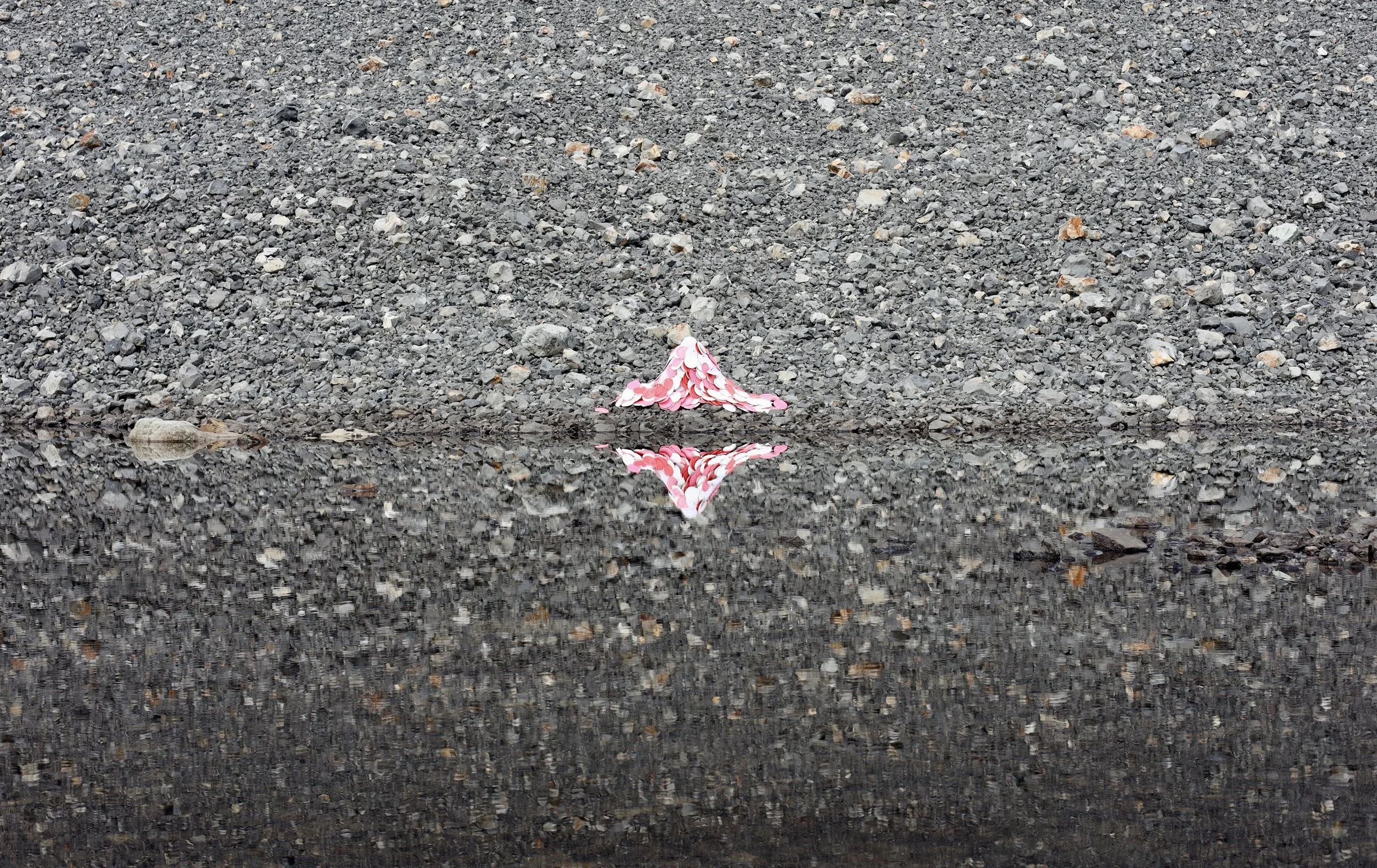
In “Nest”, movement is derived from my body’s interaction with its own data. It operates at the intersection of performance, textile practice, and disability aesthetics. I record hourly changes of my vascular malformation, its size, temperature, firmness, localized/radiating pain, and position. This record is used to build the conditions of choreography.
Each hour-entry is translated into a single, discrete textile element. The five recorded variables each determine specific material properties such as scale, density, color. These elements accumulate to construct the garment.The structure operates as a choreographic apparatus and is the mechanism through which my body’s archive becomes movement.
D’Leen Betts
D’Leen is a choreographer and interdisciplinary artist working across movement, data systems, textile construction, and site-responsive performance. Their practice investigates how choreography can be composed through the body’s continuous navigation with its environment.
Shaped by disability and a rural, remote context, D’Leen creates work that does not rely on institutional infrastructures unavailable in the north or inaccessible to their body. This crip methodology of composition demonstrates that dance does not require ideal conditions to exist. They hope to expand the field by showing that rigorous choreographic practice can emerge from bodies and places historically excluded from it. “
Contact: contact.dleen@gmail.com
Photo: Guillaume Legris
Details:
Year of creation: Prototype 2025 | Second iteration ongoing
Choreographer: D’Leen Betts
Audience Type: Families, Young Adults, Adults, Seniors
Length of work: approx 45 minutes
Preparation time required on site: one hour
Technical requirements required on-site: I would require the presenter to support basic site coordination, including permission to use the location, audience communication, and local promotion. Because this work is intended to reach people who may not normally attend formal performance events, support with community- based outreach is important. This could include sharing information through local organizations, health clinics, libraries, accessibility networks, and community bulletin boards. Because of the scale of the communities where the work will be presented, the technical requirements are minimal. These are small performances and do not require large sound systems. Previous outdoor performances I have presented in rural communities have had audiences ranging from 7–18 people, allowing me to use a small portable speaker system that does not require extensive infrastructure or power access. These events have been BYOS (bring your own seat) with a few portable chairs provided by me. As a member of the Haida Gwaii Accessibility Committee, I help identify accessible outdoor spaces on Haida Gwaii and actively monitor their conditions and accessibility status. This gives the project an accessibility advantage. Additionally I will ensure the following: 1. The audience experience is flexible. There is no fixed seating or entry point, so people can engage at their own pace, move as needed, or step away. 2. I do not use flashing or intense lights or excessive sound. 3. Performances scheduled during daylight hours and audiences informed in advance about the terrain and weather. 4. There is no prior knowledge required to engage with the work. Contextual materials and site information will be made available both before and after the performance These materials will be in French and English and will outline the structure of the work, site conditions, and ways of engaging. 5. The work is structured to support multiple points of entry. 6. Audiences have the opportunity to fill out a form (digital or physical) with access requirements (audio description, asl interpretation, etc.) prior to the event.
Space required: Approximately 4 m × 4 m performance area with stable, level ground suitable for outdoor movement performance. Additional surrounding space is needed for flexible or impromptu audience seating/viewing. Performances will take place in accessible outdoor locations selected for proximity to parking, clear pathways, and ease of access.
Availability: My objective is to tour “Nest” to communities that do not have the same access to contemporary performance as urban centres, with a particular focus on northern BC. This aligns with the project’s artistic and political framework: the work is not made for the black box and then adapted outward. It is built for places where performance infrastructure is limited, where outdoor sites, community halls, libraries, museums, and informal gathering spaces often become the real cultural venues. I am available to perform and tour the project throughout 2026–2027, with strongest availability in spring and summer, when northern roads, ferry schedules, and outdoor performance conditions are more reliable. Winter presentation is possible in selected sites, but would require more flexibility around weather and safety. My touring goals are to present the work in accessible outdoor spaces, connect with local arts and disability communities, and offer community engagement activities alongside the performance. Touring this project in BC would allow me to develop a model for crip, site-responsive choreography that can circulate without relying on conventional theatre infrastructure.
Community Engagement
I can facilitate a two-part workshop series in data costume creation and movement exploration. This grows directly from the process of “Nest” and offers participants a practical entry point into the project’s methods.
The first workshop would introduce participants to data-based costume or wearable object creation. During the residency where the project began, I informally shared my process with other artists, showing how I translated one data point into a material element. I would now formalize that activity into a workshop where participants identify a sensory dataset and translate it into a wearable form using low-cost materials. The focus would not be on technical perfection, but on developing a system: how can a feeling, number, memory, or observation become shape, texture, colour, or attachment?
The second workshop would build from the first by exploring how these wearable elements affect movement. Participants would test how objects change posture, balance, timing, gesture, and attention. This would be a gentle choreographic exploration rather than a technique class, making it accessible to people with varied movement experience and bodyminds.